ISLES IN THE OCEAN OF POSSIBILITIES
Essay by Sebastian Höglinger
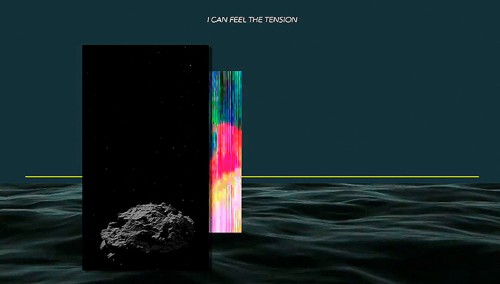
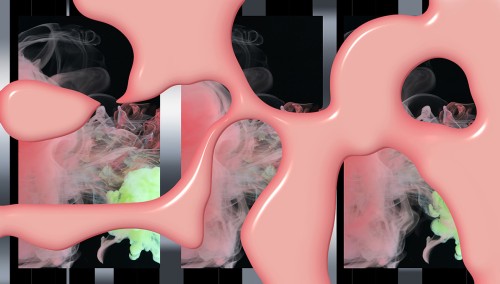
A strictly drawn line stretches across the everwaving sea. Like the ocean in Stanisław Lem’s “Solaris”, a consciousness also seems to inhabit the animated liquid entity in Dagmar Schürrer’s I WANT TO BE LIKE YOU. “My individuality is an illusion”, it says there. A sentence like a package insert for the works of the Berlin-based media artist with Upper Austrian roots to whom Crossing Europe dedicates a special program in 2024, works that reach far beyond the presentation in the movie theater.
As a matter of fact, everything in Schürrer’s video worlds seems to be in a symbiotic co-existence with everything – a state of living and being that sometimes parasitically, sometimes mutualistically thwarts any amount of the imperative individuality zeitgeist. What applies to the theories and content inspired by people ranging from the philosopher Pierre Lévy to artist László Moholy-Nagy to biologist Lynn Margulis is also translated to the technological and formal level: Digitally generated objects and (3D) animations are interconnected with partially artificial intelligence-generated text and narrations, found footage, drawings, and sound. That is how Schürrer creates novel cinematic isles in the ocean of digital possibilities. Through their contradictory, at times utopian nature, they question the self-evidence of the one-dimensional status quo and deny compelling “inner” logic.
For instance, already its title, IDEAL DEFICIENCY calls for the breach of rules: “Be absent”, “disappear in the fold”, “force yourself to forget”
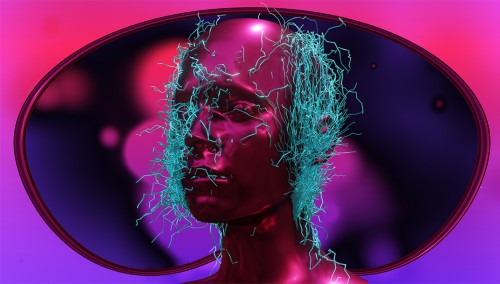
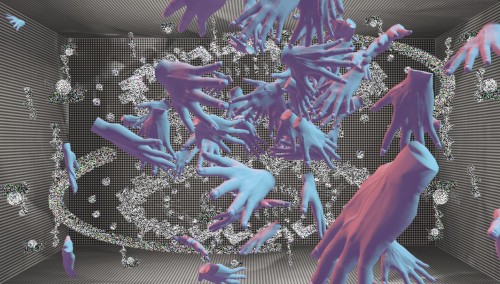
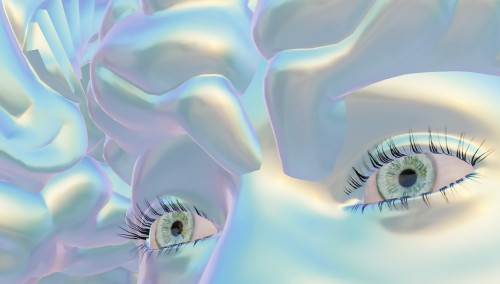
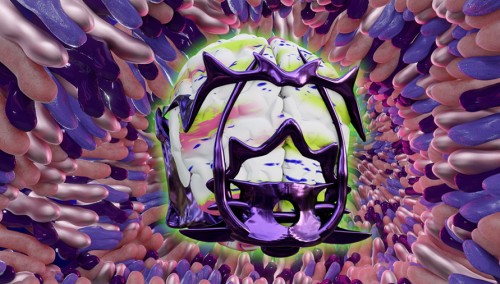
The imperative of having to function that is omnipresent in present times is broken with relish through overlapping image types and text collages, and the perfection that is also reflected in Schürrer’s unmistakably color saturated and elegant animation is juxtaposed with a vulnerability of the bodies. It is frequently separate body parts – hands, eyes, tongues – that mutate through Schürrer’s personal or AI-aided grasp or that lose themselves in a rousingly beautiful glitch. Frequently, it is also organs, like the brain in WE ARE ALREADY HISTORY AND WE DON’T KNOW IT. Right at the outset, a hypnotic tunnel leads us to the center of thought of Schürrer’s reality machine – “the ultimate machine”. As in many of Schürrer’s more recent works, what is foregrounded here instead of the previously more present written text is the spoken word. The computer-generated voice describes the junctures of AI and the biological brain, creating mental permeabilities between only allegedly separate worlds.
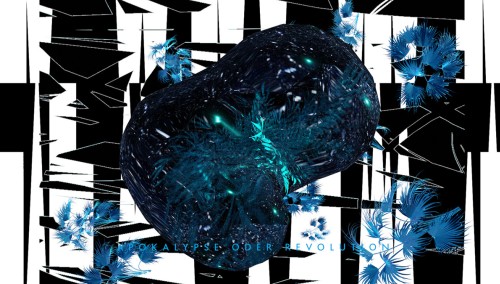
That is exactly what can be determined to be the connecting interest of Schürrer: the interlocking of organic and virtual realities and states of consciousness, of the concrete and the abstract, of efficiency and deficiency, of mistake and perfection – or also of dream and AI, in DREAMING IS THE MIND LEFT TO ITSELF, for instance. It is not unusual for the audience to lose the proverbial ground under their feet in this paradoxically multi-legged balancing act: We find ourselves in free fall, in a downright poetic maelstrom of images that constantly interweave or stack up, under or next to each other. An impressive display of this is what may be the most out-of-Schürrer’s-ordinary work in the program, the music video COUNTRY CLUB for the grand seigneur of Berlin subculture, Chris Imler. “Fuck you all”, the moustachioed man postulates there with characteristic nonchalance while Schürrer unleashes a correspondingly nonchalant video vertigo rush. The exception – rotating and falling – increasingly becomes a state. And in the second music video, as if they were reacting to it, the band Ja, Panik! asks about the ensuing consequence: “Apocalypse or Revolution?” It is exactly this deliciously playful dealing with ambiguity, virtuality, the loss of control – dystopia too – that turns the Schürrer universes into a cinematic dream destination.
Presented as a world premiere, the title of the final film in this dense special program is WHERE DOES THE REST OF THE WORLD BEGIN. Dagmar Schürrer’s answer may be somewhere out there: in the infinite ocean of possibilities – in the symbiotic interaction of cinema, the art space, and digital space.
Further links:
dagmarschuerrer.com
instagram.com/dagschu

Dagmar Schürrer © Birgit von Bally